
|
Getting your Trinity Audio player ready...
|
How rich do you think your favorite TV stars, movie producers, and actors are?
I used to think they were extremely wealthy, especially when I was younger. However, in recent years, I have observed that producers, actors, and other contributors often face challenges ensuring fair compensation for their work, as royalty payments are often delayed, opaque, or inaccurate.
The reality, however, is far more complex.
Producers, actors, investors, and other contributors often struggle to receive fair and timely compensation for their work. Royalty payments are delayed, revenue reports are opaque, and profit calculations can be difficult—if not impossible—to verify. Even films that appear commercially successful may generate little backend income for the people who helped create them.
At the core of this issue is the traditional film profit-sharing model. Built on intermediaries, fragmented accounting, and centralized control, this system makes transparent profit sharing in film production difficult—especially for independent filmmakers and smaller investors.
This is where blockchain technology transforms film industry financing. By enabling immutable records, automated execution, and transparent data sharing, it introduces accountability and efficiency into how films are funded, monetized, and distributed.
In this article, our blockchain consultants at Debut Infotech Pvt Ltd share their knowledge of the shortcomings of traditional profit-sharing models, explore how blockchain-based film financing and distribution address them, and consider what a more transparent future for film production could look like—one in which value is shared fairly among those who create it.
An Overview of Blockchain in Film Industry Financing Operations
The film industry isn’t what it used to be, particularly in how films are financed, produced, and monetized. We will briefly address the key differences. For now, we want you to know that the traditional model, with many elements, has numerous inefficiencies that make it difficult to share profits in film production transparently.
Among the many digital innovations addressing real-world problems today, the use of blockchain in film industry financing has proven invaluable. Rather than adding complexity, modern blockchain platforms simplify value exchange by supporting transparent, peer-to-peer transactions across financing, production, distribution, and revenue settlement in the film value chain.
So, how does it do this?
Let’s break it down.
At its core, enterprise blockchain development enables the film industry to build secure, scalable systems that support complex financing structures, real-time revenue tracking, and multi-party profit sharing. These enterprise-grade implementations ensure transparency, governance, and reliability across the entire film production and distribution value chain.
Traditionally, profit sharing in film production often relies on intermediaries and centralized systems. Independent filmmakers and small studios often have to go through larger, more established film houses to launch their projects and share profits.
However, with blockchain in film financing, they can now raise capital directly from global audiences using tokenized assets, thus bypassing traditional gatekeepers such as banks, studios, and private equity firms.
How do they do this?
Film tokenization represents one of the most practical blockchain use cases, allowing investors to participate directly in projects through digital assets that reflect ownership rights or revenue-sharing arrangements.
Furthermore, Smart contracts automate royalty distribution, enabling project owners to receive precise, timely payouts and, most importantly, full revenue transparency. This model not only lowers barriers to entry for filmmakers but also aligns incentives between creators and audiences.
Sounds awesome, right?
It is, indeed! However, blockchain film financing remains in its infancy and is only beginning to mature. However, as it does, the film industry is beginning to see it as a viable way to reset the blockchain revolution film industry. This is because it offers a more open, efficient, and trust-based alternative to film funding systems.
Ready to Build Transparent Blockchain Solutions for Film Production?
Transform film financing and profit sharing with secure, automated blockchain systems designed for real-world use. Partner with experienced blockchain developers to build smart contracts and tokenization solutions that deliver transparency, efficiency, and trust.
The Traditional Film Profit-Sharing Model: Key Shortcomings
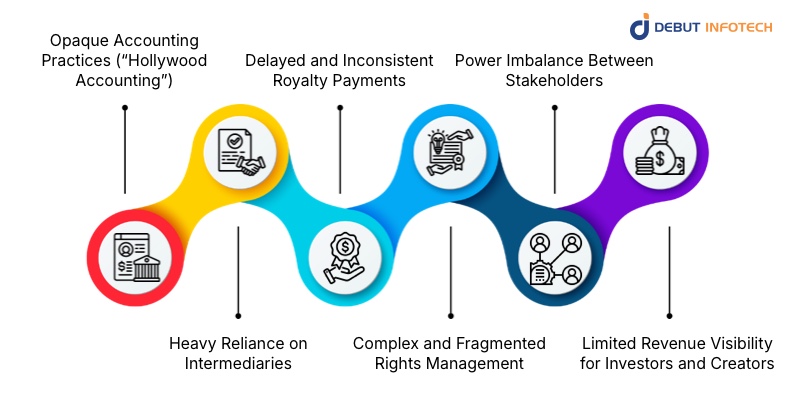
So, what are these existing inefficiencies that blockchain film distribution is trying to address in the traditional film profit-sharing model?
Let’s break them down:
1. Opaque Accounting Practices (“Hollywood Accounting”)
The term ‘Hollywood Accounting’ is a popular label for a set of creative accounting practices used by film and entertainment studios to inflate a project’s profits. These techniques usually involve deducting extensive fees, overheads, and internal charges before declaring profits.
Consequently, Hollywood often reports cases of movie projects that appear commercially successful in the media but are officially reported as unsuccessful on paper. As a result, the investors and talent who have invested ther resources in producing such movies end up receiving limited payouts.
This opacity makes it nearly impossible for stakeholders to verify revenue figures independently.
2. Heavy Reliance on Intermediaries
In the traditional film profit-sharing model, intermediaries such as distributors, sales agents, and exhibitors serve as the primary intermediaries for revenue collection and disbursement. As such, their presence in this complex “waterfall” system adds another layer of complexity to the profit-sharing system, characterized by additional fees, delays, and reporting discrepancies.
Consequently, by the time revenue reaches creators or investors, it has passed through several hands, increasing costs and reducing trust.
More intermediaries often mean less clarity, not more protection.
3. Delayed and Inconsistent Royalty Payments
Without blockchain film financing, profit participation payments are rarely made in real time. Before investors and talent receive their financial rewards, royalty statements are often issued quarterly, semiannually, or annually, and payouts may arrive months later. Additionally, errors, disputes, and missed payments are common, particularly among independent filmmakers and international rights holders. These delays disrupt cash flow and undermine confidence in the system.
4. Complex and Fragmented Rights Management
Film rights are often split across regions, platforms, and timeframes. Managing these rights through contracts and spreadsheets increases the risk of misreporting, double-selling, or missed revenue opportunities. When ownership of rights is unclear, profit distribution becomes even harder to enforce.
5. Power Imbalance Between Stakeholders
Traditional profit-sharing models also tend to favor studios and distributors with greater negotiating power. Think large, centralized structures with sufficient funding to handle massive projects. These larger organizations tend to make it difficult for independent filmmakers, smaller investors, and contributors, who often have limited leverage, restricted access to data, and little control over how profits are calculated or distributed.
This imbalance discourages participation and stifles innovation.
6. Limited Revenue Visibility for Investors and Creators
Another common issue with the traditional profit-sharing model is that most investors and creatives lack direct visibility into how and where revenue is generated. This is because the fragmented nature of the finance system means there’ll be different sales records across territories, platforms, and formats.
In response, they selectively report them, leaving stakeholders dependent on reported figures and third-party statements rather than verifiable data. This lack of revenue transparency fuels disputes and mistrust.
Now that we’ve outlined the structural flaws in the traditional film profit-sharing model, the next logical question is this:
How exactly does blockchain in film industry financing fix these problems?
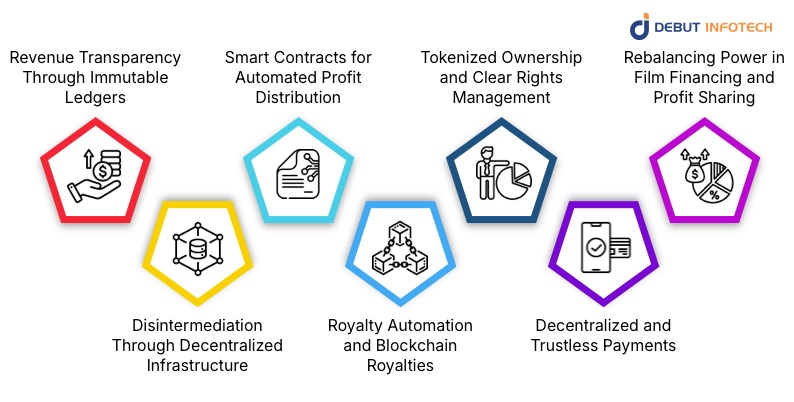
Let’s break it down—point by point.
1. Revenue Transparency Through Immutable Ledgers
With blockchain in film distribution, the opaque accounting systems of traditional profit-sharing can be replaced by a more transparent, immutable, shared ledger. In this new transparent system, every financial transaction is permanently recorded and time-stamped,
These transparent accounting systems are made possible through blockchain ecosystem protocols that govern how data is validated, recorded, and shared across decentralized networks, ensuring accuracy and immutability.
Once revenue data is recorded on the blockchain, it cannot be altered or concealed.
For film projects, this means all stakeholders, including producers, investors, and talent, can independently verify revenue figures in real time. They can all independently observe how the revenue fluctuates over time. And as such, instead of relying on studio-reported statements, participants gain direct access to verifiable data. This effectively eliminates the ambiguity that enables “Hollywood accounting” practices and restores trust in reported profits.
2. Disintermediation Through Decentralized Infrastructure
One of the most immediate advantages of blockchain film distribution and financing is disintermediation. This refers to the elimination of traditional intermediaries such as major studios, distributors, and agents, enabling independent investors and filmmakers to reach their target audiences and consumers directly and profit without restrictions.
Blockchain film financing helps achieve this level of revenue transparency by facilitating peer-to-peer value exchange and, in the process, reducing the industry’s reliance on sales agents, aggregators, collection agencies, and even banks. Ultimately, the introduction of blockchain profit distribution helps to reduce fees, shorten payment cycles, and simplify the revenue waterfall. As a result of this decentralized payments and royalty automation, a greater share of a film’s earnings reaches the people who actually created and funded it, without unnecessary friction.
3. Smart Contracts for Automated Profit Distribution
Smart contracts are self-executing programs that automatically enforce predefined rules. In the case of transparent profit-sharing in film production, the same smart contracts can be used to clearly define and encode standard profit-sharing arrangements and formulas for movie projects. More importantly, the created agreements and sharing formula can then be embedded directly into the blockchain.
When revenue for these projects begins to flow, smart contracts can automatically calculate and distribute funds according to the agreements embedded in the blockchain. This means you don’t need to invest in manual accounting, which automatically reduces the number of disputes and facilitates accurate, on-time payments. In short, smart contracts replace trust-based promises with code-based certainty.
4. Royalty Automation and Blockchain Royalties
Royalty automation means automatically triggering the distribution of the proceeds from the intellectual property (IP) payments for a particular creative project, say a film in this instance. Film tokenization and blockchain film financing can facilitate profit distribution once profits are realized by linking revenue events directly to payouts. The implication is that creators and investors don’t have to wait long to receive royalty statements. Rather, they receive their profit payments as soon as the revenue is generated.
It gets better! The fact that these blockchain royalties are processed transparently allows artists always to verify their potential earnings and associated dates. And you know what that means for independent filmmakers and international collaborators: they can receive instant payments and avoid missed payments in a once-traditional system.
5. Tokenized Ownership and Clear Rights Management
Through film tokenization, blockchain in film industry financing creates clear, verifiable records of ownership and revenue participation. Tokens or NFTs can represent equity stakes, revenue shares, or usage rights, all recorded on-chain.
This approach simplifies fragmented rights management by replacing scattered contracts and spreadsheets with a single authoritative source. When ownership is clear and programmable, profit distribution becomes enforceable rather than negotiable.
6. Decentralized and Trustless Payments
Blockchain enables decentralized payments that do not rely on centralized financial institutions. Funds can be distributed globally without currency conversion delays or excessive transaction fees.
These trustless payments ensure that profit distribution is based on verified data rather than institutional discretion. For global film productions, this creates a faster, fairer, and more inclusive financial infrastructure.
7. Rebalancing Power in Film Financing and Profit Sharing
Finally, blockchain film financing helps tip the scales in favor of independent creators and investors, who were once at the mercy of intermediaries and larger institutions under the traditional model. With tokenized ownership, creators can raise funds directly from their audiences and from investors who share their vision. These tokenized models reduce their dependence on centralized studios and financiers.
Independent filmmakers now have greater control over financing terms, income reporting, and profit sharing as a result of this change. By doing so, blockchain helps restart the blockchain revolution in the film industry toward a more equitable model, rather than merely optimizing the current system.
The Future of Transparent Profit-Sharing in Film Production
So far, we’ve seen the structural flaws of the traditional profit-sharing model in film production. We’ve also seen how blockchain technology addresses these flaws in reshaping independent filmmaking and redefining the flow of value within the film ecosystem.
But what does this mean for the future of transparent profit-sharing in film production?
From the perspectives of independent filmmakers and investors, blockchain film financing is a key way to avoid studio-dependent funding and raise capital directly from their global audiences, thereby retaining greater control over rights and profit distribution. The implication is that, in the foreseeable future, filmmakers may no longer need to rely on centralized institutions for capital, as they can now raise funds independently while retaining full ownership.
Additionally, blockchain technology makes all key stakeholders more accountable across revenue channels.
Here’s how:
Blockchain technology introduces smart contract functionality that facilitates on-chain reporting, enabling easier tracking of earnings from revenue streams such as streaming, video-on-demand, and international sales. This level of transparency eliminates the risk of discrepancies. It ensures equitable profit distribution, so creators receive an adequate share of profits that reflects the performance of their work.
The pay for artists is likewise subject to substantial adjustment. Payments can be made immediately upon revenue generation through blockchain-based royalty systems and automation. Cast, crew, and collaborators—especially those historically excluded from timely backend participation—now have stable revenue streams.
The growing adoption of blockchain in entertainment is also driving new models of fan ownership, community funding, and audience participation that extend beyond traditional film financing structures.
By enabling viewers to become stakeholders, film tokenization links monetary rewards with artistic achievement. In addition to providing financial support, these decentralized groups can help with marketing and distribution.
Transparent profit sharing in film production could become the norm if blockchain adoption spreads widely. This would be enabled by immutable ledgers, trustless payments, and automated profit-distribution systems that prioritize efficiency, accountability, and fairness.
Transform Film Financing With Blockchain Automation
Whether you’re building tokenized film financing platforms, automated royalty systems, or transparent profit-sharing solutions, our team delivers end-to-end blockchain development that improves efficiency, transparency, and trust.
Conclusion — The Future of Transparent Profit Sharing in Film
Opaque accounting, delayed royalties, and fragmented rights management were the norm in traditional profit-sharing in the film industry. Creators and investors were once unaware of how revenue was generated or distributed, and ultimately left with a small share of the profits.
But with blockchain, the film industry now has a more practical alternative based on smart contracts, immutable ledgers, royalty automation, and tokenized ownership. As a result, the profit-sharing process is now more transparent, efficient, and fair. These tools enable real-time revenue tracking and automated payouts, reducing reliance on intermediaries and restoring trust across the value chain.
Successfully implementing these systems requires more than just technology—it demands experienced execution. Debut Infotech Pvt Ltd, a blockchain development services provider, helps organizations design and deploy secure, scalable blockchain solutions tailored to their needs in film financing, distribution, and profit sharing.
As blockchain adoption grows, it could make transparent profit sharing the norm rather than the exception in film production.
Frequently Asked Questions (FAQs)
A. Every transaction on a blockchain is recorded in an immutable shared ledger accessible to all authorized users. This eliminates the need for third-party statements and opaque reporting systems, enabling stakeholders to verify revenue, ownership, and payments independently.
A. By eliminating intermediaries, automating payments, and ensuring precise tracking of rights, revenue, and ownership throughout content lifecycles, blockchain in entertainment sector increases transparency, efficiency, and trust.
A. Blockchain secures transactions through immutable ledgers, decentralization, and cryptographic validation. Records are transparent, verifiable, and impervious to fraud and manipulation because once data is recorded, it cannot be changed without network consensus.
A. Indeed. By automatically computing and distributing payments when revenue is generated, blockchain technology enables royalty automation. This guarantees prompt, accurate blockchain royalty payments without human intervention or delayed reporting.
A. Because it enables direct funding through tokenization, reduces reliance on studios, and offers clear profit-sharing procedures that safeguard both investors and creators, blockchain film financing is especially appropriate for independent filmmakers.


