|
Getting your Trinity Audio player ready...
|
Can you still remember why cryptocurrencies and the blockchain were developed?
Yes, there were a couple of factors surrounding them, but it all boils down to “enabling peer-to-peer transactions without the need for trusted intermediaries like banks.”
But do you think crypto exchanges are making that possible?
These days, rising security risks have led regulatory agencies to tighten their grip on these exchange platforms, and the truth is, it’s hard to tell them apart from banks anymore.
That’s where anonymous crypto exchanges come in — platforms built for a world where privacy, speed, and control matter more than ever. Anonymous exchanges offer something radical yet increasingly relevant: a way to buy, sell, or swap crypto without disclosing your personal information.
In this article, we’ll unpack what these platforms are, how they work, and what sets them apart from traditional exchanges. You’ll also discover the opportunities they open up for businesses and the risks worth paying attention to.
And if you’re a decision-maker exploring how to build or scale a crypto exchange platform, this deep dive will help you understand where the market is heading — and how Debut Infotech Pvt Ltd is helping businesses stay ahead by creating compliant, privacy-focused exchange solutions that balance innovation with integrity.
Ready to build a privacy-first crypto exchange platform?
Work with our blockchain experts to design and develop an anonymous crypto exchange that balances privacy, security, and compliance.
Understanding the Basics About Anonymous Crypto Exchanges
An anonymous crypto exchange is a digital trading platform that allows users to buy, sell, or swap cryptocurrencies without requiring them to provide personal details such as names, addresses, or ID documents. They can simply create an anonymous account and start trading.
I recently tried trading some crypto on a new platform, and the number of security checks, personal information, and verification I had to go through made me feel like I was at the immigration office. All that doesn’t happen at an anonymous exchange crypto.
They are not like traditional exchanges that require strict Know Your Customer (KYC) verification. In fact, these platforms either minimise or eliminate identity checks or also known as no kyc anonymous crypto exchanges.
Users who visit these networks have more control over their privacy as a result. To put it simply, they enable transactions without creating a digital paper trail tied to an individual’s physical identity.
Why is the concept of an anonymous cryptocurrency exchange still so tempting to so many individuals in a world when there are so many security risks?
One of the main causes has been the ongoing threat to people’s data privacy over the past few years. Concerns that people feel continuously monitored after disclosing personal information on social platforms have grown. As a result, many traders and investors prefer the freedom of no KYC, anonymous crypto exchanges because they allow them to move assets more fluidly across borders, without waiting for approvals or worrying about surveillance.
Wondering about some examples of crypto anonymous exchange platforms that allow these?
Here are some:
- Bisq
- Uniswap
- BingX
- CoinEx
- Changelly
These and many more options have been known to emphasise user privacy while still maintaining transparency on the blockchain.
But anonymity does not equate to immunity or invisibility. Even if privacy is the first priority in an anonymous cryptocurrency exchange arrangement, it still operates within a digital ecosystem where transactions are publicly recorded. Therefore, businesses and users should be aware that the lack of KYC merely moves responsibility rather than eliminating it. After all, choice and trust are just as important to true anonymity as technology.
Also Read: Crypto Exchange Development for Institutional Investors: Key Features Needed
How do Anonymous Crypto Exchanges Work?
Have you ever traded crypto on a traditional exchange?.
The process usually involves sign-up forms, selfie verification, and long waiting times while your ID “gets approved.” Anonymous crypto exchanges flip that entire experience on its head. Instead of asking who you are, they simply ask: What do you want to trade?
So, how do these anonymous crypto exchanges actually make that possible? The answer lies in how they’re built.
Most of them run on decentralised technology, which means there’s no single authority holding your funds or your data. Instead, you connect your own wallet directly to the platform. From that moment, you’re in full control of your assets. No central storage. No risk of your ID being hacked. This design principle is what defines most no KYC anonymous crypto exchanges today.
Still don’t get the full picture?
Here’s a more technical summary of what goes on in the background:
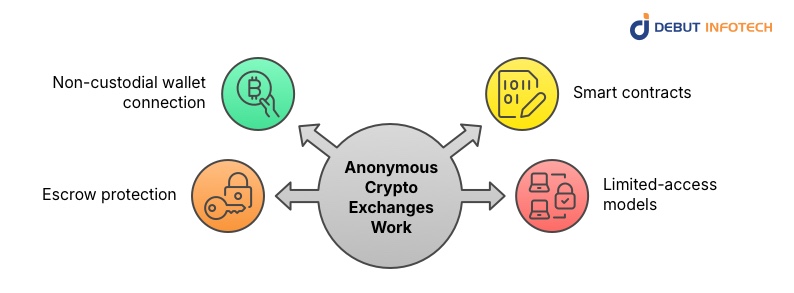
- Non-custodial wallet connection: Users already have their personal crypto wallets, which they can now connect to the exchange and trade directly from. This way, money never stays with the exchange.
- Smart contracts: Anonymous crypto exchanges use smart contracts that automatically execute a deal without human approval once both parties agree to and fulfil the terms of the trade.
- Escrow protection: Multi-signature escrow systems are used by some platforms (such as Bisq or Hodl Hodl) to secure peer-to-peer transactions, guaranteeing that both traders fulfil their responsibilities before assets are released.
- Limited-access models: Some centralised exchanges require KYC only for higher limits and initially allow smaller, anonymous cryptocurrency transactions.
So, it is safe to say that, at its core, every crypto anonymous exchange runs on one simple promise: trade freely, without surrendering control or identity.
However, just as we mentioned earlier, you should remember that anonymity isn’t invisibility. Be aware that every transaction (even those on anonymous crypto exchange platforms) remains on the blockchain. As such, they are still visible to anyone who looks closely enough.
The concept of privacy here is more about minimising your exposure.
Read: Scaling Your Crypto Exchange Business – A Practical Roadmap
Key Distinguishing Features of Anonymous Crypto Exchanges
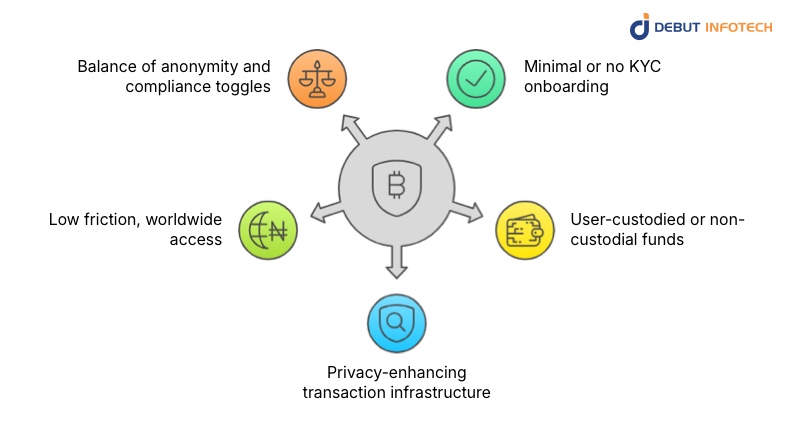
When you ask what sets an anonymous crypto exchange apart, it comes down to a few bold features.
Many executives and decision makers seeking a KYC crypto exchange or an anonymous no kyc crypto exchange often ask this question, and the following are some features we often tell them to look out for:
- Minimal or no KYC onboarding: Crypto anonymous exchanges allow users to start trading with minimal personal information, such as email addresses and wallet connections. They do not involve extensive identity checks.
- User-custodied or non-custodial funds: Anonymous crypto exchanges do not hold the user’s wallet keys. Instead, the user maintains control over their wallet keys and only has to connect the wallet to the exchange to execute a trade. This structure lowers custody risk and data exposure.
- Privacy-enhancing transaction infrastructure: Anonymous crypto exchanges use techniques such as mixing, stealth addresses, or simpler verification to ensure that trade data on their platforms isn’t easily linked to an identity.
- Low friction, worldwide access: These platforms are appealing to users in jurisdictions where banking access is restricted or where identity data is sensitive, making them attractive to markets that prioritise privacy.
- Balance of anonymity and compliance toggles: Anonymous crypto exchanges have infrastructures that make them flexible enough to serve both individuals with high privacy needs and cater to the regulatory requirements of enterprises.
Consequently, our decentralized crypto exchange development services at Debut Infotech recognise these features as core building blocks for quality, privacy-focused and enterprise-grade anonymous crypto exchanges. The focus is on building a platform with real commercial and compliance sense.
So, how do these features differentiate an anonymous crypto exchange from a traditional crypto exchange?
Find out in the next section as we place both platforms side by side.
Differences Between Traditional Crypto Exchanges and Anonymous Crypto Exchanges
Here’s a snapshot for you:
“ Traditional exchanges focus on compliance and regulation; anonymous ones focus on privacy and control.”
However, to get more detailed information on how these two categories of crypto exchange platforms differ, consult the table below. We have broken down how each model works so that you have all the facts as you decide on which platform you eventually decide to build or trade in:
| Criteria | Traditional Crypto Exchange | Anonymous Crypto Exchange |
| User Verification (KYC) | Mandatory: users must submit IDs and proof of address before trading. | Optional or non-existent, no KYC anonymous crypto exchanges often allow instant trading. |
| Custody of Funds | Exchange holds user assets in custodial wallets. | Users retain full control of funds through personal wallets. |
| Privacy Level | Limited; user and transaction data are often stored and monitored. | High; minimal data collection and often on-chain pseudonymity. |
| Accessibility | Restricted in certain jurisdictions; compliance-driven limitations. | Broad cross-border access, ideal for users who value privacy or face local restrictions. |
| Transaction Speed | Sometimes slower due to verification processes. | Faster onboarding and execution with fewer checks. |
| Regulatory Oversight | Heavily regulated; adheres to KYC/AML rules. | Lightly regulated or self-regulated; relies on user responsibility. |
| Risk Exposure | Lower for users but higher data vulnerability. | Higher regulatory risk but stronger privacy protection. |
Why Should You Use an Anonymous Crypto Exchange? – Pros
Imagine launching a crypto-exchange where users come not because you asked for their ID, but because you respected their privacy. That’s the core appeal of an anonymous crypto exchange. For business leaders and platform builders, this isn’t just about saying “we’re private” — it’s about unlocking a market segment hungry for discretion, speed and control.
Here are some key advantages why users love anonymous crypto exchanges and why you should build one as a crypto executive or startup founder:
- Enhanced user privacy and reduced data liability: Users love platforms that request less data and offer greater privacy. Therefore, when you minimise or eliminate personal data collection, you’re attracting their attention because it shows that your platform reduces the attack surface for data breaches, leaks, and identity theft.
- Faster onboarding and global accessibility: Users in underserved areas, high-growth markets, and privacy-conscious demographics want to trade in minutes rather than hours or days. An anonymous crypto exchange gives them that because there is no need for extensive KYC paperwork. This can be a key attractor for tapping into such markets.
- Differentiation in a crowded market: If your platform is built by a team like Debut Infotech Pvt Ltd with privacy-first architecture, you position it as a “best anonymous crypto exchange” offering — appealing to users who won’t settle for “just another exchange.”
- User-custody models and decentralised infrastructure: The platform becomes an infrastructure provider rather than a custodian of funds when users are responsible for their own wallets and keys. This reduces the risk profile of your business model.
- Access to privacy-first communities and emerging geographies: Many traders in regions facing heavy banking or identity friction are drawn to “crypto anonymous exchange” models. The opportunity to serve that demographic can be significant.
Related Read: Choosing the Top Crypto Exchange Development Companies in 2025
Risks and Considerations Associated with Using Anonymous Crypto Exchanges – Cons
Clearly, there are so many positives to using anonymous crypto exchanges.
However, you also have to be wary of some very real risks. The following are some major considerations you should take seriously before leaning fully into this privacy-first model, either as an individual user or platform builder:
- Regulatory and legal uncertainty: It is sometimes unclear whether anonymous or low-KYC exchanges are legal, especially across different jurisdictions. Sometimes, regulatory agencies like the Financial Action Task Force (FATF) flag these platforms as posing a high AML/CFT risk because they lack standardised identity controls. The implication is that your operations may be disrupted or shut down, leading to a loss of funds.
That’s why quality crypto exchange companies like Debut Infotech Pvt Ltd carry out thorough legal checks for their clients when building one.
- Illicit activity exposure and reputational risk: Inherently, the fact that you know so little about the user’s identities since you request little or no personal information increases the chances of these platforms being used as conduits for money laundering, sanctions evasion, or other illicit flows. The implication is that it may trigger regulatory action and damage your brand image.
- Security and operational vulnerabilities: While the anonymity of these crypto exchanges drastically reduces some data risks, it also amplifies serious security and operational vulnerabilities. For example, the lack of traditional oversight may expose the platform itself to hacks, scams, and misuse.
- Limited customer support and recourse: The anonymity approach often means fewer protections or fewer governments willing to assist if users encounter problems such as technical malfunctions, disputes, or frozen funds. When striving for enterprise-grade service, that is important.
- Liquidity, growth and institutional hesitation: While privacy is attractive, many large players prefer platforms with strong compliance, transparency and trust. An anonymous model may slow institutional adoption or access to banking rails.
In the end, you’ll need to strike a balance between design flexibility and the risk framework if you’re considering developing or running a privacy-first cryptocurrency platform. In addition to trading features, the architecture should demonstrate how you will safeguard users, comply with evolving regulations, and uphold your reputation.
Transform Your Crypto Exchange with Privacy-First Innovation
Leverage our proven blockchain expertise to build secure, user-centric, and fully customizable anonymous crypto exchange platforms that balance privacy with performance.
Conclusion
Now you know that anonymous crypto exchanges aren’t just about secrecy but also about choice. They change the order of things with traditional exchanges by giving users control over their data and funds. From non-custodial wallets and smart contracts to flexible KYC options, these platforms are reshaping what privacy in crypto can look like.
Still, they’re not without challenges. Regulatory pressure, security risks, and the fine line between privacy and compliance continuously pose considerable threats to their use and global adoption. Therefore, the key to getting the best out of them, either as a user or a platform builder, lies in balance. This means platform developers must endeavour to create systems that protect users without isolating them from the global financial framework.
That’s where we come into the picture. With deep expertise in blockchain technology and crypto exchange architecture, Debut Infotech a renowned crypto exchange development company helps enterprises design crypto platforms that combine the best of both worlds: user privacy and regulatory trust.
Because in the next chapter of crypto innovation, those who build responsibly will lead confidently.
Frequently Asked Questions (FAQs)
A. Trading is permitted on several platforms without full identification verification. Bisq, Uniswap, PancakeSwap, Hodl Hodl, and Changelly are a few examples. The degree of privacy offered by these exchanges varies; some are completely decentralised and non-custodial, while others allow smaller trades to be partially anonymous before requiring verification. Always start by reviewing local laws.
A. Because trades take place directly between users’ wallets without the need for middlemen, decentralised exchanges (DEXs) offer greater anonymity than centralised platforms. On public blockchains, transactions are still accessible; therefore, they are not entirely anonymous. “Pseudonymous” is frequently a fairer term because DEXs safeguard identity but not transaction transparency.
A. Indeed, certain cryptocurrencies prioritise anonymity and privacy. Advanced encryption algorithms are used by coins like Monero (XMR), Zcash (ZEC), and Dash (DASH) to conceal transaction details like sender, recipient, and amount. Although they improve privacy, traceability issues have attracted regulatory attention in some areas.
A. Regulatory scrutiny, possible fraud or money laundering, a lack of recourse in the event that something goes wrong, and decreased liquidity or institutional support are among the risks. Weaker oversight may increase users’ vulnerability.
A. These platforms frequently provide minimal data collection, non-custodial user wallets, and direct wallet-to-wallet trading. To hide connections between identities and transactions, some use cryptographic techniques like mixing, stealth addresses, or smart contracts.


