|
Getting your Trinity Audio player ready...
|
Introduction
Imagine your sales team is using a traditional CRM. Each day, the team must update customer data, compose follow-up emails, monitor deal status and proactively check which deals may be in trouble. The system keeps the data, but it’s still up to your team to think and take action.
Now imagine using an AI SaaS solution. An AI-native CRM can transcribe and summarize sales calls, detect when deals are at risk, recommend the next action to take, generate follow-up emails, and even automate workflows. Rather than just managing tasks, the software helps manage decision-making and speed up processes.
This is the difference between traditional SaaS and AI SaaS.
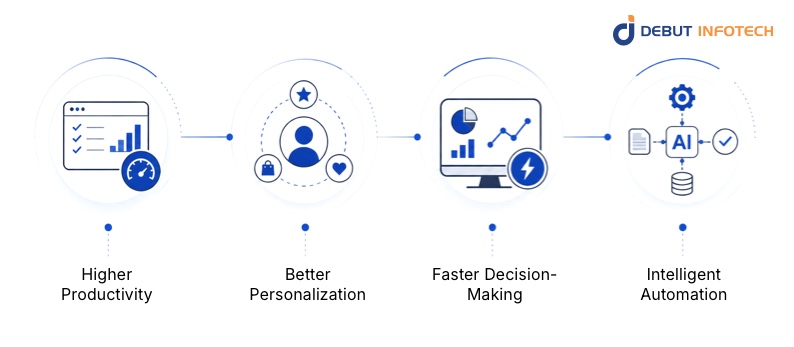
Traditional SaaS transformed the way organisations use software through cloud computing. AI-native SaaS is doing more than that by transforming software. It’s no longer about reports, forms or manual data entry. It is about intelligent systems that can analyze context, automate repetitive work, personalize experiences, and support smarter business decisions.
But this does not mean all firms should replace their current SaaS systems. It is about making the right decision based on workflow complexity, data quality, compliance needs, cost, security and readiness to embrace AI-driven processes.
In this article, we will discuss AI SaaS vs traditional SaaS in practical terms, so you can see how they differ, the advantages and disadvantages, how they can be used, and the factors to consider before you decide which model is best for your company.
| Comparison Area | Traditional SaaS | AI-Native SaaS |
| Core function | Helps users manage and complete tasks | Helps users automate, predict, recommend, and complete tasks |
| User experience | Built around forms, dashboards, menus, and reports | Built around conversations, smart prompts, predictions, and guided workflows |
What Is Traditional SaaS?
Traditional SaaS is cloud-based software that companies access via a web browser or mobile application. Rather than having to install software on each computer or host it on company servers, businesses pay for the software to be hosted online for a monthly or annual subscription fee.
This approach has been a game-changer for many organisations. It makes software easier to access, easier to update, and usually more affordable than building and maintaining everything internally.
A traditional SaaS product is typically:
- Hosted in the cloud by the vendor
- Paid for through monthly or annual subscriptions
- Built around user-driven workflows
- Designed with standard dashboards, forms, and interfaces
- Configurable, but not always deeply adaptive
- Updated and maintained by the software provider
- Priced by user, seat, feature tier, or usage level
Common examples include CRM systems, HR platforms, accounting tools, project management software, email marketing platforms, and helpdesk solutions.
Traditional SaaS is best known for its stability. Companies can rely on what is offered: established processes, price, and updates, as well as a stable user interface. Traditional SaaS continues to be a great fit for teams that require organization, control and consistency.
But the downside is that the majority of traditional SaaS systems are still largely manual. This means that users must update records, transfer tasks from one system to another, and review reports and initiate actions. This can be a challenge for teams that are dealing with a lot of data, complex customer interactions, or multiple systems.
That is why businesses are now weighing up traditional SaaS with AI SaaS platforms. Traditional SaaS helps businesses manage their work, while AI SaaS is built to help automate, predict, recommend and accelerate work.
Ready to move beyond traditional SaaS?
Build intelligent AI-native SaaS solutions with Debut Infotech for smarter workflows, automation, and scalable business growth.
What Is AI-Native SaaS?
AI-native SaaS is software that uses artificial intelligence as the foundation for how the product works. It’s not just SaaS with some added AI functionality. Rather, AI is built into the product, and influences how the software processes data, how it helps the user understand data, how it automates processes, and how it learns to improve processes over time.
In other words, traditional SaaS typically helps us manage tasks. AI-native SaaS helps people manage, understand and advance work more intelligently.
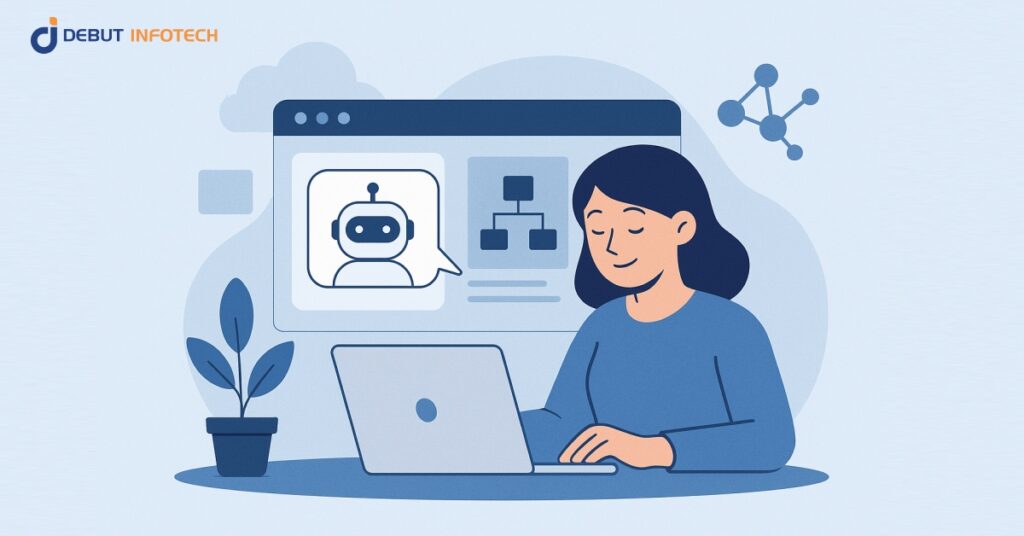
For instance, an AI-native SaaS solution might let the user ask questions in natural language, create summaries, anticipate customer actions, suggest actions, or automate repetitive tasks across multiple enterprise systems. This means that the software becomes more than just a tool, it’s an embedded intelligent assistant built into daily operations.
Key Features of AI-Native SaaS
AI-native SaaS solutions are designed to do more than organize data or processes. They leverage artificial intelligence to learn user preferences, automate tasks, process business data, and help make decisions quickly. This makes the software more flexible, predictive and valuable to your business.
AI-native SaaS software is typically built to:
- Leverage AI models as part of the product design
- Automate tedious and repetitive tasks
- Learn from user and business data
- Understand natural language commands and dialogues
- Offer predictive insights, not just retrospective reporting
- Suggest actions based on the current situation
- Employ AI agents to automate tasks within workflows
- Provide flexible pricing options, including usage-based, outcome-based or hybrid pricing
This is also why companies looking for custom software development are no longer just interested in simple cloud-based apps. They want software that can spot trends, decrease the need for manual work, and help them make decisions more quickly. They want software that does more than store information.
What Are the Risks and Limitations of AI-Native SaaS?
AI-native SaaS can help software be more efficient, intelligent, and automated. But as with all powerful tools, it does have its risks, which businesses should be aware of before using it.
The real question is not only “Can this AI tool save time?”
It is also “Can we trust its output, protect our data, and stay in control of important decisions?”
1. Inaccurate or Hallucinated Outputs
One of the biggest risks of AI-native SaaS is that the system may produce answers that sound confident but are incorrect.
For example, an AI tool may:
- Summarize a customer conversation incorrectly
- Recommend the wrong next step in a sales process
- Misread financial, legal, or healthcare-related information
- Create a response that looks accurate but lacks proper context
In some low-risk applications, this might only lead to a minor error. But in critical areas like finance, health, law, recruiting, or customer service, flawed AI results can impact business operations and human lives.
2. Prompt Injection Attacks
Prompt injection is another serious concern. This occurs when someone seeks to undermine the AI system by providing it with hidden or malicious instructions.
For example, an attacker may try to make the system:
- Reveal private company data
- Ignore security rules
- Produce misleading information
- Trigger actions it should not perform
OWASP identifies prompt injection and insecure output handling as major risks in large language model applications because they can lead to data exposure, poor decisions, and wider security problems.
3. Poor Explainability
Another risk is that AI systems don’t always provide transparent explanations for their decisions.
With traditional SaaS, for instance, a user can see how an action was taken if it was based on a rule, setting, or workflow. With AI-native SaaS, the reasoning may be harder to understand.
This can create problems when teams need to answer questions like:
- Why did the AI recommend this action?
- What data did it use?
- Can we prove the decision was fair?
- Can we explain this to customers, auditors, or regulators?
For high-risk or regulated industries, explainability is not just helpful. It is essential.
Not sure if AI-native SaaS is right for you?
Talk to Debut Infotech and discover the best SaaS path for your business.
How Debut Infotech Helps You Build AI SaaS Without the Common Risks
Developing an AI SaaS product is not as simple as automating tasks or including a chat bot within a cloud-based software platform. It needs product strategy, scalable and secure architecture, data governance, user experience design, and understanding of how software is used by businesses to enhance their operational and business performance.
As a top SaaS development company, Debut Infotech assists startups, enterprises and emerging businesses with turning existing software into smart, AI-enabled platforms. We assist businesses in every step of the process with product discovery, MVP development, AI-powered capabilities, cloud development, API integration, workflow automation, security, performance, and scaling after launch.
Our approach is to create solutions that help business goals, not just technology that looks impressive. Whether it’s to increase productivity and automate tasks, support quick decision-making and enhance customer experiences, Debut Infotech turns SaaS concepts into real business outcomes.
Whether you’re looking to transform an existing product or create a next-generation AI-powered SaaS product, Debut Infotech delivers the technical expertise, product thinking, and delivery capabilities to help you scale.


